
City Know-hows

Peri-urban landscapes and the potential of integrated foodscapes to support healthy cities

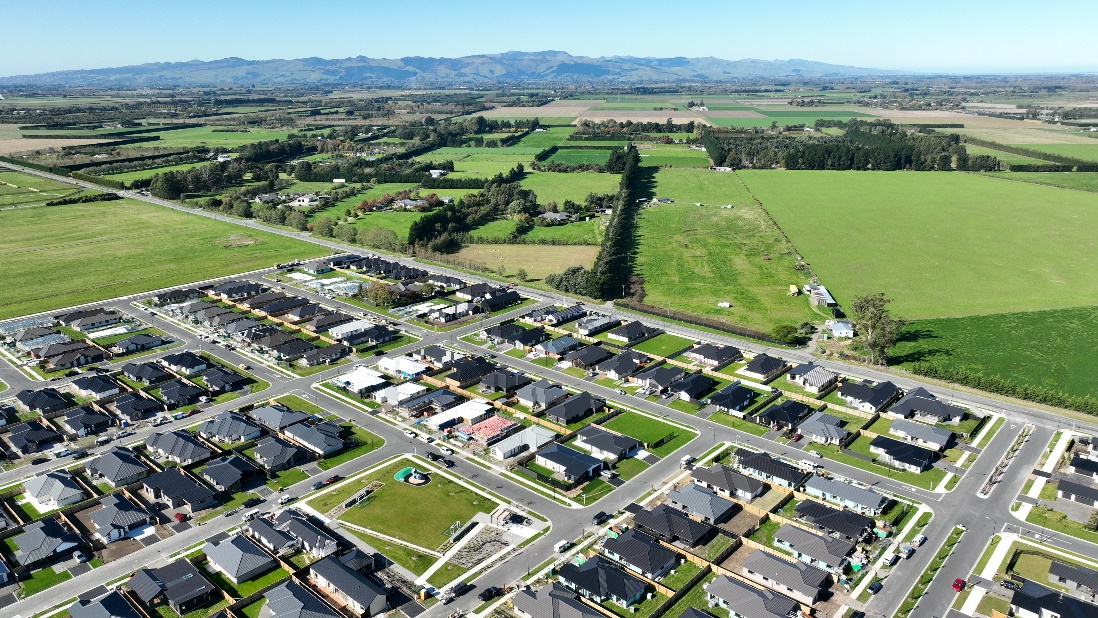
Land use change by greenfield residential expansion onto productive agricultural land within the peri-urban zone of Ōtautahi Christchurch, Aotearoa, New Zealand. Photo: Don Royds, 2023

As the global urban population grows, food production and housing are currently ‘competing’ with each other for land on the edges of cities. Both essential urban components, this research supports town planning and urban design professionals to explore alternative peri-urban land use typologies, where food production and housing co-exist for greater urban health and resilience.

Share

Target audience

Town planners, urban designers, peri-urban communities.

The problem

With rapid population growth and urbanisation, the edges of towns and cities, once seen as productive hinterlands in support of urban communities, are experiencing unprecedented land use change. The rapid spatial expansion of urban areas onto productive agricultural land is seeing cities become increasingly disconnected from the landscapes that feed them, with food production pushed further away. In a world of global disruption caused by severe weather events, pandemics, and human conflict, access to local food, we contend, is essential to the long-term health of cities.

What we did and why

Using a ‘design thinking’ methodology, we engaged both residents and food producers living and operating within the peri-urban zone to explore the question ‘how can food production and housing best co-exist at the edges of cities and settlements?’ Using the case of Ōtatuahi Christchurch, Aotearoa New Zealand, we developed five participant-driven land use ‘scenarios’ that explore the spatial relationship between housing and food production, providing alternative approaches to peri-urban land use design into the future.

Our study’s contribution

Peri-urban food production is today understood as a necessary pathway towards urban health and resilience. Using the case of Aotearoa New Zealand, the research demonstrates an effective methodology for engaging stakeholders through ‘design-thinking’. Our findings translate community aspirations into future land use scenarios, where housing and food are integrated for mutual benefit. Our research re-prioritises food production as an important and necessary land use close to cities ensuring holistis urban health where food production considered alongside housing, clean water, and fresh air.

Impacts for city policy and practice

Planning for the future of peri-urban zones, globally, is challenging, with planning policy and practice often contested, and ‘successful’ solutions elusive. Our study focused on exploring how spatial design can positively contribute to the mediation of competing land use demands in the peri-urban zone, namely housing and food production. Our findings will be instrumental for future policy development, planning practice, and urban design, where the co-existence of housing and food production is essential for long-term city health.

Further information

‘Ministry for the Environment, New Zealand’ https://environment.govt.nz/acts-and-regulations/national-policy-statements/ for more about the legislative planning context of Aotearoa New Zealand, and, https://environment.govt.nz/publications/our-land-2021/ environmental reporting on land use change.

‘Stanford Design School’ https://dschool.stanford.edu/resources/getting-started-with-design-thinking good for learning more about ‘Design Thinking’.

‘Nature communications’ https://www.nature.com/articles/s41467-020-14386-x for information and reference links to understanding global projections of future urban land expansion.

Full research article:

Leave a Reply

Your email address will not be published. Required fields are marked *

Related posts

Lessons from a car-free settlement for child-friendly urban mobility

Our study focuses on active and independent mobility of children in a car-free settlement which can be promising for developing policies for a child-friendly urban future and mobility justice for children. The outputs of this study can bridge the gap between vehicle-oriented and non-vehicle-oriented settlements and enable the transfer of good experiences.

Read More »

Informing the design of public greenspaces to optimise wellbeing outcomes for the general population

Our findings highlight how different features including sounds of flowing water, open seating areas, far-reaching views, and a variety of planting (colour, height, texture, scents, attracting wildlife) within a garden influence emotional reactions and perceived restoration. These findings help build a wider picture of the lived experiences of garden users and how their wellbeing may be influenced by specific garden features. We intend our findings to support design guidelines of public greenspaces concerning human wellbeing.

Read More »

How can we reconnect mental and urban health?

Our study found that community place-based initiatives involving the public and private sectors can provide public spaces, such as public parks and communal gardens, that are appropriate for reconnecting mental and urban health using the concept of co-benefit endorsed by the World Health Organization in 2011. We examined this concept in large projects in Seoul and Singapore to show the advantage of intersectoral collaboration for reconnecting mental and urban health initiatives by urban planning.

Read More »