City Know-hows

Illegal firework activity and environmental sound levels: Community impacts and solutions

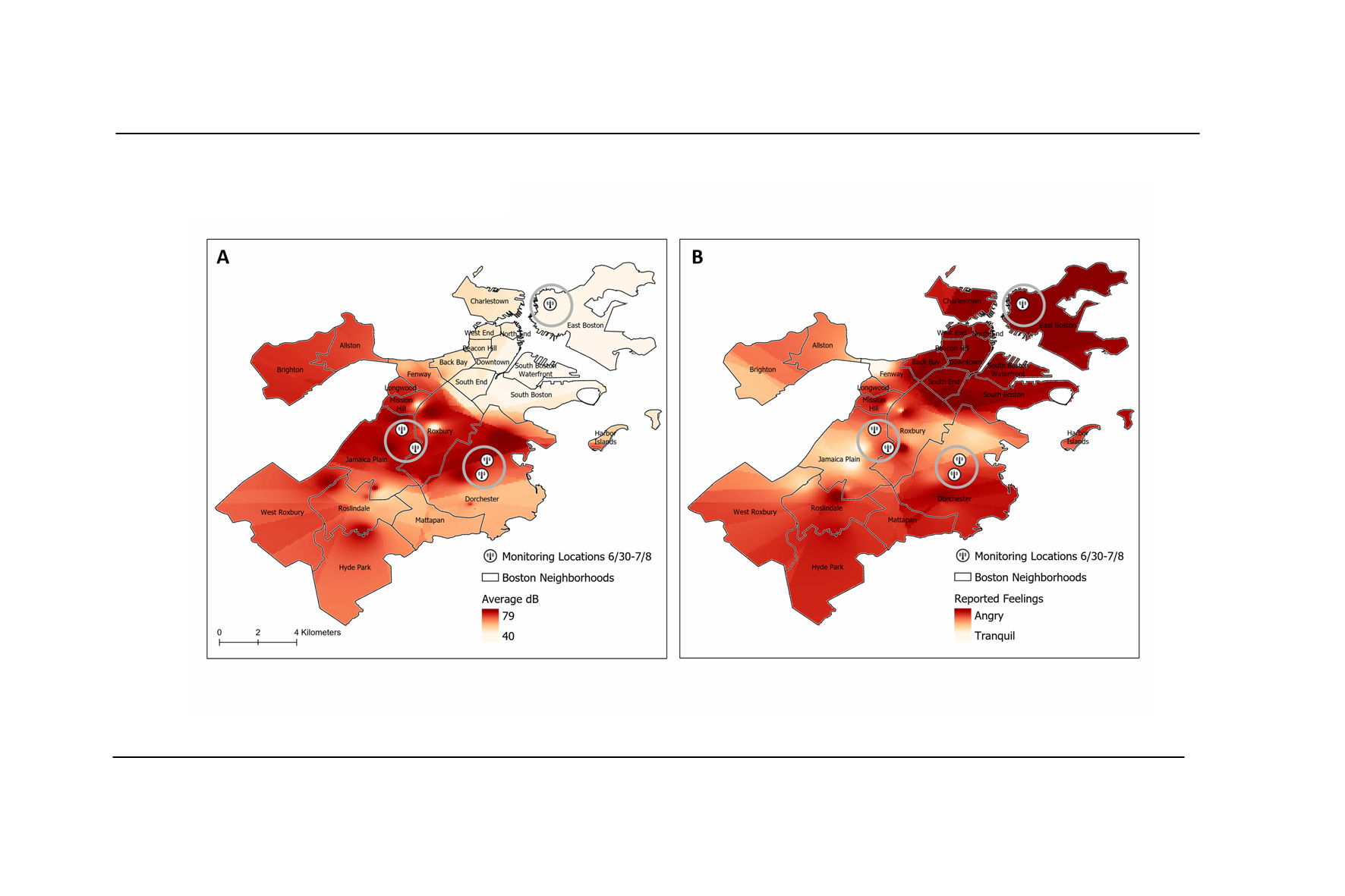
‘NoiseScore’ smartphone app heat map data identifying firework hotspots based on (a) community-measured sound levels and (b) community subjective reports.

Target audience

City planners, city officials, residents, community and public health committees.

The problem

Concerned residents reached out to a local research group (Community Noise Lab) and city officials to complain of the significant mental and physical health impacts of incessant firework activity during Covid-19’s stay-at-home advisory.

What we did and why

Community residents, city officials, and academic researchers come together to measure and problem solve incessant illegal firework activity in the City of Boston. We used a research app called ‘NoiseScore’ together with sound level meters, noise complaint calls, and census data to measure sound levels. These data allowed us to also be able to describe its impacts on community noise perception; map who is most vulnerable to such noise; and used these data to form the first ever Firework Task Force in the city of Boston. 

Our study’s contribution

We explain the process of how a group of academic researchers, city officials, and concerned residents can come together to measure, report, and create a fireworks taskforce.

Impacts for city policy and practice

This experience can be informative for cities and/or community residents who need to organize around an environmental issue and create a tangible, effective solutions.

Further information

Community Noise Lab:  Community Noise Lab is currently located at the Brown University School of Public Health. The lab’s primary aim is to holistically explore the relationship between community noise and health by working directly with communities to support their specific noise issues using real-time monitoring and exposure modelling. Our smartphone app, NoiseScore, which allows users to objectively measure and subjectively describe noise events in their community.

City of Boston – Fireworks Safety Guide: Sound levels from incessant use of fireworks are unreasonably loud. The City of Boston states that unreasonable sound levels are anything louder than 50 decibels from 11pm to 7am, or anything louder than 70 decibels at anytime.

Full research article:

Firework activity and environmental sound levels: community impacts and solutions by Erica D. Walker, Nina F. Lee, Koen F. Tieskens, Jonathan Jay, Lorrie J. Walker, Marisa Luse, Roudnie Celestin, Jerome Smith, Julia Mejia & Jonathan I. Levy.

Leave a Reply

Your email address will not be published. Required fields are marked *

Related posts

Are we building for health? Food environments in transit-oriented development, New South Wales 

The built food environment has a significant influence on population health, for better and for worse. Evidence shows that urban planning can play a major role in creating food environments that support healthy food choices; however current transit-oriented developments have not yet considered access to healthy food outlets. We found evidence that a high proportion (79 – 84%) of food outlets could be classified as ‘unhealthy’ across eight transport hubs identified for accelerated development in New South Wales.
Read More »

A psychology and power intervention to help decision-makers prioritise health in ­­­urban development

Evidence overwhelmingly suggests that the built environment has an impact on people’s health, particularly in terms of noncommunicable diseases such as asthma, diabetes and poor mental health. However, health is rarely prioritised in urban planning decisions at present, and earlier work by this research group has shown that senior decision-makers feel they lack the power to influence planning and policy decisions in order to improve the situation. This intervention area adds to the wider research programme, which is focused primarily on the delivery of quantifiable socio-environmental and health economics valuations. People make decisions not just based on economic valuation, so an understanding of why people make decisions and how those decisions can change is essential. This paper describes the methodology that will be used to develop this intervention. Findings will be published later.
Read More »